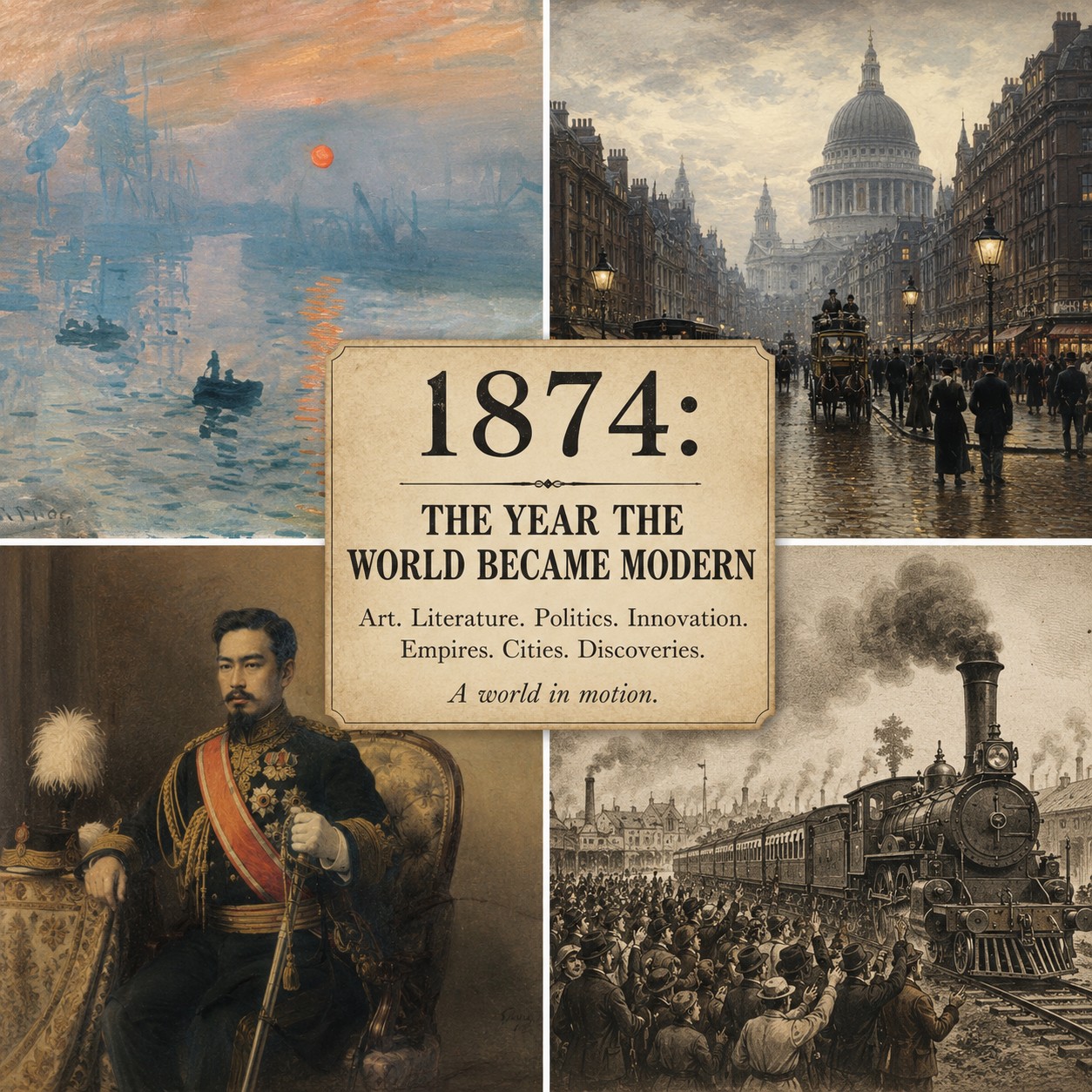
1874: The Year the World Became Modern
Not literally, of course. History does not turn on a single calendar page.
But imagine opening a newspaper in Paris in 1874.
Claude Monet and a group of troublesome young painters have just exhibited works that critics consider unfinished: visible brushstrokes, fleeting light, railway stations, cafés, dancers and ordinary people enjoying an afternoon. One painting—Impression, Sunrise—will accidentally give the movement its name.
Charles Dickens has been dead only four years. George Eliot has just published Middlemarch. Tolstoy is writing Anna Karenina. In America, Mark Twain is finding a distinctly American literary voice, while Emily Dickinson is quietly writing poems almost no one will see during her lifetime.
Bismarck’s newly unified Germany is three years old. Queen Victoria presides over an empire reaching across the globe. The United States is emerging from the Civil War, struggling over Reconstruction and racing westward along a transcontinental railroad completed only five years earlier.
On the Atlantic coast, New York is becoming a city of factories, finance, immigration and extraordinary wealth. On the Pacific coast, California is being connected to the nation through railways, agriculture and trade—while Indigenous peoples are displaced and Chinese laborers face growing hostility.
Across the ocean, Japan is only six years into the Meiji Restoration. A society recently organized around feudal lords and samurai is building railroads, factories, schools and a modern army with astonishing speed.
Everything is moving.
Steamships compress oceans. Railways compress continents. The telegraph compresses time. Cities swell. Department stores, newspapers, photography and advertising create the beginnings of mass culture.
Literature becomes the moral X-ray of the new society. Dickens writes about poverty, money and class. George Eliot examines marriage, medicine and frustrated idealism. Dostoevsky explores guilt, faith and the divided mind. Zola studies human beings as products of heredity and environment. Ibsen turns the respectable home into a political battleground.
Art also changes its subject.
For centuries, great paintings had largely concerned gods, kings, saints and battles. Now artists paint train stations, laundresses, cafés, prostitutes, dancers, parks and people walking down the street.
Art stops depicting eternity and begins depicting Tuesday afternoon.
Meanwhile, Darwin has challenged humanity’s place in creation. Germ theory is beginning to transform medicine. Electricity, the telephone, recorded sound and eventually the X-ray will alter the boundaries between distance and presence, darkness and light, life and memory. By the end of the century, the foundations of our world are already visible: industrial capitalism, enormous cities, mass immigration, global communication, consumer culture, modern medicine, nationalism and empire.
So are the unresolved tensions that will define the twentieth century: democracy versus imperial power, scientific progress versus inherited belief, spectacular wealth versus mass poverty, individual freedom versus vast political and industrial systems.
The nineteenth century began with most people living locally, traveling at the speed of a horse and understanding themselves through inherited communities.
It ended with people riding trains, reading mass-produced newspapers, speaking across distances, seeing the world through photographs and imagining themselves as citizens, consumers, workers—and private psychological selves.
The nineteenth century did not merely invent modern life.
It invented the modern person, then delivered that person—exhilarated, ambitious and dangerously unsettled—into the twentieth century.
#TheModernRaconteur #ArtHistory #History #Impressionism #TheModernWorld #BirthOfTheModernWorld